






Skip to: site menu | section menu | main content


Shortcuts to Hit Songwriting

Buy at Amazon

Write a Song

Songwriting Tips

Songwriters' Sandbox

Song Resources

Study the Hits

Blog & News

Join my Email List for more tips & updates...
(Your email address is always private.)

Guestbook

For daily songwriting tips, follow me on... Twitter


Praise for Robin's book...

"For people serious about writing great songs. It's got it all!"
~Kara DioGuardi, hit songwriter & American Idol judge


"Should be in every songwriter's arsenal."
~Jason Blume, hit songwriter, author

Shortcuts to Hit Songwriting

Buy at Amazon

"An excellent road map for writers at all levels. This is the songwriter's GPS!"
~Ralph Murphy,
V.P. ASCAP Nashville


"126 sharp tools, tips, exercises, and insights for every stage of creating your songs."
~John Braheny, author

Back to top

Study the Hits!

You can easily keep up to date with the techniques that are being used by today's hit songwriters. Just check out recent hits you like and figure out what makes that song appeal to you. It's an essential skill if you want to write songs that are competitive and expressive, and it's a lot of fun! Hit songs can be full of surprises and can inspire you to try new ideas in your own songs .

by Robin Frederick

(c) 2009 All rights reserved.

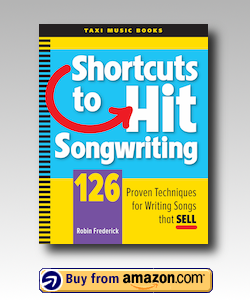
For those of you who have my book, "Shortcuts to Hit Songwriting," I've referred to the Shortcuts that can tell you more about the ideas discussed here. If you don't have my book, you can click on the book image in the upper left-hand corner. It will take you to the Amazon.com page where you can buy it.


STUDY THE HITS:

"Fallin' For you" - Colbie Caillat (Genre - Pop)

"You Belong With Me" - Taylor Swift (Genre - Pop/Country)

"Come On Get Higher" - Matt Nathanson (Genre - Pop/Singer-Songwriter)

"Sounds Like Life to Me" - Darryl Worley (Genre - Country)

"Sound of Madness" - Shinedown (Genre - Mainstream Rock)

"Waking Up In Vegas" - Katy Perry (Genre - Pop)

"Crush" - David Archuleta (Genre - Pop)

"One In Every Crowd" - Montgomery Gentry (Genre - Country)

"If I Were A Boy" - Beyoncé (Genre - R&B)

"Gotta Be Somebody" - Nickelback (Genre - Pop/Rock)

"Here" - Rascal Flatts (Genre - Country)

"I'm Yours" - Jason Mraz (Genre - Pop/Singer-Songwriter)


"CRUSH" - RECORDED BY DAVID ARCHULETA

(Jess Cates / David Hodges / Emanuel Kiriakou)

Buy this song at iTunes.   Lyrics are available on the internet.
Shortcut # refers to my book "Shortcuts to Hit Songwriting."


THEME
The theme of this song -- falling in love but not knowing whether the other person feels the same -- is one that has been explored in many hits The songwriters will need to create a fresh point of view in order to get the listener's attention. (Shortcut #38.) By focusing the chorus on a series of questions, "Crush" emphasizes the insecurity and anxiety of the situation, at the same time letting listeners know, indirectly, exactly what the singer is feeling.

STRUCTURE
The structure does not follow the usual hit song form. It opens with an 8-line verse ("I hung up the phone tonight..."), followed by a pre-chorus ("Why do I keep running...") and a chorus ("Do you ever think..."). All of this is just what most hit songs would do. (Shortcut #26.)

Things change in Verse 2. The first four lines of Verse 2 repeat the melody from Verse 1 but the second half of Verse 2 has a melody that listeners haven't heard before. It sounds like a variation on the verse melody and has the same lyric form, so that's most likely what it is. This section segues directly into the second chorus with no pre-chorus, creating plenty of forward momentum.

There's no bridge in this song; after the second chorus, it goes to the pre-chorus, then repeats the chorus to the ending. The second pre-chorus may have been cut both to enable the song to get to the chorus sooner and so that it could be used as a bridge without creating too much repetition in the song. It's an interesting solution to a problem.

Try this structure in a song of your own. Just make sure you can get to chorus from either the verse or pre-chorus. "Crush" uses the same chord progression in both verse and pre-chorus which helps to solve that problem.

The structure is Verse / Pre-chorus / Chorus / Verse / Chorus / Pre-chorus / Chorus to fade out.

MELODY
There's a great example of contrast between sections in this song. Not only is the chorus melody in a higher note range than the verse or pre-chorus, but it also has a very different melodic rhythm. The melodic rhythm of a song is the result of using a combination of short and long notes to create a pattern. (Shortcut #88 and #95.)

In the first four lines of the chorus, the pattern of long and short notes is clearly Short-Short-Short-Short-Long. Then the melodic pattern changes, emphasizing the downbeats for two lines. After that, the whole pattern is repeated. The melodic rhythm patterns in the verse and pre-chorus are quite different from the chorus; they feature more of a see-sawing Long-Short-Long-Short-Long pattern.

The Payoff Line: The final line of the chorus is one that listeners will remember so it needs to be a compelling closer. This chorus ends with a catchy "yay-ee-yay-ee-yay" on the final word that extends the chorus and creates a memorable hook.

LYRICS
The first line of the first verse sets up a specific situation ("I hung up the phone tonight / Something happened for the first time / deep inside, it was a rush"), drawing listeners immediately into the singer's situation with physical and emotional detail. Then the second half of the verse sets up the feeling of anxiety that's going to dominate the chorus ("the possibility that you would ever feel the same way...it's just too much).

The pre-chorus (beginning with the line, "Why do I keep running...") sounds somewhat generic lyrically; the "hypnotized/mesmerized" rhyme is a familiar one., It's not a particularly fresh lyric but it does make the point that the singer is deeply in love, describing the strength of the crush and leads listeners in the questions of the chorus. However, since this section is going to be repeated for the bridge, I feel the writers could have made better use of the lines; with a little work they could have been more compelling and original.

The chorus lyric is where this song really shines. The short phrases create a sense of breathlessness and urgency, while the series of questions adds drama. And all the while the singer is asking questions, he's telling listeners what he himself feels.

DO IT NOW!
Because the chord progression is so repetitive, as well as being very familiar, this is an easy song to learn and play. Try using it as a "ghost song" to practice your skills. Write a new lyric and melody to this chord progression. Be sure you don't use any of the hit song's melody or lyric. (Shortcut #2.)

Copyright 2009 Robin Frederick.


To Top of Page

"ONE IN EVERY CROWD" - MONTGOMERY GENTRY

(Ira Dean / Kim Tribble / Eddie Montgomery)

Buy this song at iTunes  Lyrics are available on the internet.
Shortcut # refers to my book "Shortcuts to Hit Songwriting."


Talk about an irresistible bunch of fun! This song has listener appeal from the first line to the last and here's how they do it...

STRUCTURE
The song structure is a basic Verse / Pre-chorus / Chorus / Verse / Pre-chorus / Chorus / Bridge / Chorus, with an EXTRA "Hey y'all" hook.

The first pre-chorus begins "Well, he's a big mouth yellin'..." The pre-chorus section has a powerful, repetitive feel that builds anticipation leading into the chorus, just as it should! That's the function of a pre-chorus!

There's a secondary hook in the irresistible, anthemic "Hey, y'all!" This is icing on the cake! The chorus itself is so strong (beginning with "There's one in every crowd...") that the song doesn't require another hook. Still, it's bound to attract plenty of listeners who will want to sing along. It's a fun interlude but doesn't payoff the verses well enough to work as a stand-alone chorus. Keep that in mind when you write a catchy phrase like this.

LYRICS
Everything in this lyric is focused on painting a character portrait that really brings that "one in every crowd" to life! It's a case study in how to SHOW listeners what's happening and make them EXPERIENCE it! Every line includes an image, example, or detail that adds to listener's picture of this person (Shortcut #57 and #58).

The real challenge of writing a lyric about a character like this is that it's been done so often. The "life of the party" down at the corner bar has been a staple of Country songs for decades. Take a look at how this lyric approaches an old theme with a fresh eye, making the audience see it for the first time. The lyric uses conversational, accurate observations: He's a six-pack up when he walks in / Tells the band "Crank it up to 10!" and humor -- he "makes everybody else look sane" -- to make the point.

These writers did something very smart: The chorus lyric gives this guy a positive role to play; he "brings the party in us out." If that line weren't there the character might just be another irritating drunk. But this concept makes him much more likable.

Notice how the writers use highly specific details, song titles, and proper names to create believability: "Free Bird" "flip-top box of Marlboros" "Golden Tee." When a cliche does appear ("good time Charley"), it pays off with a fun rhyme ("with a Harley"). And speaking of payoffs, the all-important final line of the chorus has a nice twist in it -- "and it's usually me." A strong chorus payoff gives listeners a sense of satisfaction and completion. A chorus without a payoff line is like a joke without a kicker! (Shortcut #50)

MELODY
The verse is a series of short phrases with a natural, conversational melody. After that, the longer phrases of the pre-chorus stretch out, building tension as they lead into a big chorus release. The chorus is in a higher note range than the verse, adding urgency and energy.

The chorus melody opens with two short phrases followed by a long one, then the two short melodic phrases are repeated, leading the listener to anticipate that the 4th line ("there's one in every crowd...") will be the same as the 2nd line ("good time Charley..."). In a nice fake-out, the 4th line begins the same as the 2nd line but quickly changes and delivers the payoff ("it's usually me"). This "fake play" is a favorite with listeners, creating an expectation and then a surprise twist. (Shortcut # 94)

DO IT NOW!
Try using some of these lyric and melody writing techniques in a song of your own. Choose a character and create a lyric portrait filled with detail and imagery. Don't forget to give your listeners a reason to care about your character. Use a 'fake play' in your chorus melody; set up a pattern of phrases, then repeat the first part of the pattern but instead of completing it, go somewhere new for your payoff line.

Copyright 2009 Robin Frederick.


To Top of Page

"IF I WERE A BOY" - BEYONCÉ

(Toby Gad / Britney Carlson / Beyonce Knowles)

Buy the MP3 at Amazon.com  Lyrics are available on the internet.
Shortcut # refers to my book "Shortcuts to Hit Songwriting."


STRUCTURE
This song starts with the vocal - no waiting around for the intro to go by! We're dropped right into an unusual situation: a girl who wishes she were a boy. The song structure is Verse / Chorus / Verse / Chorus / Bridge / Chorus.

LYRICS
These lyrics are conversational, honest, and direct. There's no poetic language here, yet there are emotional insights into the theme of being hurt in a relationship. The female singer imagines herself in the male role - the freedom, the simple everyday advantages that a boy takes for granted. This is a distinctive approach and offers a fresh emotional take on the theme (Shortcut #38).

The first verse doesn't have an obvious rhyme scheme, no predictable ABAB line-ending rhymes here! Instead, there are rhymes inside of lines: in Verse 1 roll / throw / go, kick it / stick it, and wanted/confronted . This kind of rhyming is borrowed from Hip-hop with its internal rhymes that occur frequently and unpredictably.

The second verse does have a rhyme scheme. In the R&B/Soul genre, this kind of variation between Verse 1 and Verse 2 is fairly common. The general rule is: Move from less to more, not the other way around. In other words, if you start out with a rhyme scheme (more), don't drop it later on (less). Listeners are expecting to hear the rhyme scheme they heard before.

Notice how the verses portray the man's freedom while the choruses focus on how the female singer would act; she would be a "better man." The bridge offers a powerful contrast, dropping the pretense for a moment and allowing the singer to directly confront "you."

MELODY
The really interesting thing about this song is that the melody is the same in both the verse and the chorus. The chorus simply moves the melody up an octave to add urgency, energy, and intensity. This trick isn't unique. You can hear something very similar in the Goo Goo Dolls' huge Pop hit, "Iris" (aka "I Just Want You To Know Who I Am"). You can also hear it in "First Time," a hit for Lifehouse in 2008 in which the chorus melody is a repeat of the prechorusan octave up.

There's a ton of repetition in this song melody! The verse repeats the same melody twice, the chorus does the same an octave higher. A melody with this many repetitive sections risks becoming predictable, but there's something very unusual going on... something that keeps the listener off balance. Every line of this melody begins on a different beat!

Since each verse melody changes slightly due to variations in the lyric, let's look at the chorus to get an idea of what's going on here.

In the chorus, the first line begins on Beat 3 and ends on Beat 1 of the following bar.
(If I were a boy)
The second line begins on Beat 2 and ends on Beat 1 of the following bar.
(I think I could understand)
The third line begins on Beat 4
(How it feels to love a girl)
The fourth line begins on Beat 1!
(I swear I'd be a better man)

The chorus then repeats this series of phrase starts, adding two additional phrases on the end that both emphasize Beat 1.

Using so many different starting points for phrases, gives the listener a feeling of unpredictability. We're never exactly sure when the singer will begin. Beat 1, that familiar anchor point, is often emphasized but is seldom the starting point. It isn't until the very end of the chorus, when a series of phrases strongly indicate Beat 1 ("lose the one you wanted," "taking you for granted," "everything you had") that we get a sense of a familiar place (Shortcut #91).

The use of unpredictable starting points for phrases is characteristic of many of today's R&B/Soul hits. And it's turning up more and more often in Pop, Rock, and even Country melodies. (Check out George Strait's "I Saw God Today.") "If I Were a Boy" is a great song to use as a ghost song if you're interested in embedding this melody writing technique (Shortcut #102).


Copyright 2009 Robin Frederick


To Top of Page

"GOTTA BE SOMEBODY" - NICKELBACK

(Chad Kroeger)

Buy this song at iTunes  Lyrics are available on the internet.
Shortcut # refers to my book "Shortcuts to Hit Songwriting."


Chad Kroeger of Nickelback is a songwriting ace. When he aims for a hit single, he doesn't miss! He knows how to catch the listener's attention and hold it, especially with his melody. You can use many of the same tricks that Chad uses -- they're not difficult at all! Remember, I'm not suggesting that you try to sound like Nickelback, just blend some of these techniques with your own sound to create a unique, distinctive song style with plenty of listener appeal.

Here's a look at "Gotta Be Somebody," a huge Hot AC hit for Nickelback, written by lead singer Chad Kroeger..

MELODY
Verse: The verse opens with an ear-catching but simple melodic pattern -- two held notes on the words "this time." The same pattern is repeated on the words "feels like" and again on "this life." The melody has established a repeated pattern that gives the listener an anchor, something to hold onto that provides a sense of organization (Shortcut #88).

If Kroeger continued to repeat the same pattern after the third time, it would begin to feel predictable. Instead, he delivers two short phrases ("the one we all dream of / but dreams just aren't enough"). These two short phrases break up the series of repeats and offer something fresh. Then, he can repeat entire section to create a double verse.

Notice how Kroeger uses an overall mix of long and short notes in the verse melody, creating rhythmic patterns that make it both easy to remember and attractive to listeners.

Prechorus: The first prechorus begins with the line "So I'll be holding my breath..." He uses four short phrases that echo each other rhythmically, building tension to the final phrase which he extends by a few of extra syllables ("forever with"). This is a great way to build anticipation leading up to your chorus (Shortcut #86).

Chorus: The chorus is a series of eight lines that use the same melodic rhythm. This could start to feel predictable very quickly. Add to this the fact that every phrase begins on Beat 1 (and the four-chord progression underneath is very repetitive) and this chorus could be in trouble very quickly. What saves it is the sense of forward momentum created by the very short pauses between each line. Each pause gives the singer barely enough time to catch his breath before roaring right on into the next line. This melody has the forward momentum of a freight train carrying the listener along for the ride (Shortcut #92)!

And look at what happens at the end of the chorus -- it runs right into the beginning of the second verse. There's no break, no instrumental recess between the end of the chorus and the start of the next verse. It's almost as if the brakes on the train have failed and this song is on an inevitable rush all the way to the end. Listeners love going along for a ride like that!

LYRICS
The opening lines clearly set up the theme of the song. By the third line -- "The one we all dream of / But dreams just aren't enough" -- it's apparent what this song is going to be about!

The prechorus smoothly delivers the listener right into the waiting arms of the chorus. Notice how the end of the prechorus leads straight to the word "because" at the top of the chorus. Often words like this -- "so," "because," "and," "but" -- are implied, if not actually sung at this point. This is a great way to test whether your verse or prechorus leads effectively into your chorus. Try saying (or thinking) one of these words in the transition going into the chorus. If you can't, you might want to rewrite the lead-in line, the one that sets your listeners up for your big chorus payoff (Shortcut #55).

The chorus sums up the emotional message at the heart of this song and it's one we can all identify with. The language is conversational and authentic. It sounds honest, as if the singer just thought of what he is saying. Yet, there are repeated phrases that create a sense of symmetry and tie things together: "'Cause nobody..." "'Cause everyone..." "gotta be somebody..."

This song uses a very simple chord progression that you can easily learn to play on guitar or keyboard. If you're interested in writing in the Pop/Rock genre, try using this song as a ghost song to practice writing repeated melodic rhythm patterns and forward momentum (Shortcut #2).


Copyright 2009 Robin Frederick


To Top of Page

"HERE" - RASCAL FLATTS

(Robson / Steele)

Buy this song at iTunes   Lyrics are available on the internet.
Shortcut # refers to my book "Shortcuts to Hit Songwriting."


SONG STRUCTURE
The song structure is the one that's used in so many of today's hit singles:
Verse / Pre-chorus / Chorus / Verse / Pre-chorus / Chorus / Bridge / Chorus.

The chorus begins with the line "And I wouldn't change a thing..." and ends with an emotional payoff in the final phrase "here, right here." Notice how this phrase is set up with a short pause that gives it more weight and draws attention to it (Shortcut #96).

The pre-choruses both begin with the phrase, "I know now..." The bridge flows right out of the second chorus so it's a little hard to spot. It actually starts with the last word of the chorus (and the title of the song): "here... in a love I never thought I'd get to." The word "here" does double duty as the end of the chorus and beginning of the bridge, a great way to keep the song flowing forward and pull the listener right into the bridge. Try this technique in one of your own songs as a transition between sections.

LYRICS
This lyric is a good example of taking a familiar theme - Love - and approaching it from an unusual angle. Actually, it reminds me of another Rascal Flatts hit, "Bless the Broken Road." The message is: Love is worth the struggle it takes to find and appreciate it. Here, the struggle is treated in more depth and detail than in "Bless the Broken Road."

The first verse uses a group of poetic images - "in and out of buildings" "behind windows, walls, and doors" - to suggest someone who has essentially kept himself at a distance from others. And sure enough, the lines that follow support that idea; the singer didn't stay in any relationship for very long. This is an effective use of the family of associations that come with certain images (Shortcut #58).

The chorus lyric builds intensity in the first four lines, culminating in the singer stating that he would relive a broken heart "on the day that it was breaking." Raising the stakes over a series of lines is a creative way to draw your listeners into your song.

Every line in the chorus includes an image or action word. By using visual and physical words, the song avoids making abstract statements about how the singer feels. Abstract statements leave listeners out in the cold. Get them involved in your song by giving them words they can see and feel (Shortcuts #57 and #62).

The rhymes are simple and don't call attention to themselves. This is a conversational lyric, giving the impression that the singer is revealing personal feelings in an honest way, as if he just thought of what he's saying. Keeping the rhymes simple and unobtrusive adds to the believability of the lyric.

MELODY
This melody is another beauty from Jeffrey Steele, a master class in contemporary Country melody writing. Here are some things to listen for:

The verse melody consists of two very short phrases, followed by a long phrase. This pattern is then repeated with a little variation to keep it interesting. Notice how the long third line runs right up to the beginning of Line 4 ("...walls and doors / And I thought I found it...") Use this idea to add forward momentum to your melody, pulling listeners into the next line just when they expect to take a little rest!

The pre-chorus melody begins with a three smooth, held-out notes ("I know now..."), very different from the chatty verse melody, creating contrast that gets noticed. This is followed by a couple of repeated melodic phrases ("the place that I... Was you right here..."). Repetition like this creates tension, dynamically building the listener's sense of anticipation going into the chorus. And the chorus does not disappoint...

The chorus opens with a big interval jump. It's an octave from the end of the pre-chorus to "wouldn't change a thing" in the first line of the chorus! A jump like this grabs the listener's attention and makes it clear the song has moved to a new emotional level (Shortcut #93).

Notice that the chorus melody, like the verse melody, also features two short melodic phrases followed by a longer one, then repeats that pattern before arriving at the final payoff line. This is a melodic pattern that's very appealing and memorable. Try writing a chorus melody of your own based on this pattern (Shortcut #90).

There are many more useable, exciting techniques in this song that you can apply to your own melodies and lyrics. It's well worth studying if you're interested in writing for today's hot Contemporary Country market. Use it as a "ghost song" to practice sharpening your skills in this major, hit-driven genre. For more on "ghost songs," read my article on this site: "Notes On Songwriting."


To Top of Page

"I'M YOURS" - JASON MRAZ

(Jason Mraz)

Buy this song at iTunes   Lyrics are available on the internet.
Shortcut # refers to my book "Shortcuts to Hit Songwriting."


"Happy songs" can often end up sounding merely shallow and predictable. I'm sure that's one of the reasons songwriters tend to avoid them, opting for darker, weightier themes instead. (Everyone sounds cooler when they're singing about a broken heart.) But you don't have to limit yourself to "heavy" themes in order to sound hip, thoughtful, and unique.

Jason Mraz's No. 1 Adult Contemporary hit, "I'm Yours," is a great example of an upbeat, feel-good song that still manages to convey depth in the lyrics and interesting twists in the melody, keeping listeners involved from beginning to end.

SONG STRUCTURE
The song has an interesting structure:
Verse / Short Chorus / Verse / Chorus / Bridge / Verse / Chorus.

The final chorus is a duet with the background singers singing the chorus melody and Mraz repeating a verse. The chorus always begins with the line "I won't hesitate no more, no more" and ends with the title in the payoff line, "I'm yours." The first time we hear the chorus, he sings just the opening line and payoff line, dishing up the key lines from the chorus as a kind of appetizer. (Shortcuts #25, #50, and #119)

MELODY
Mraz does a neat trick with this melody. The note range in the verse and chorus is essentially the same. And in both verse and chorus the melody has a lot of small jumps - leaping over 2 or 3 notes on its way up or down the scale. So much 'same-ness' between verse and chorus could be the kiss of death. Listeners crave contrast in the melody - it grabs attention and helps to give them a clear road map through the song. (Oh, we're in THAT section!) Jason Mraz uses a strong shift in the RHYTHM OF THE MELODY to provide that contrast. This is a great example of a technique you might want to try. To find out how he does it...

Count along with the underlying rhythm of the song throughout the verse and chorus. (Count 1 - 2 - 3 - 4 for each bar.) Notice how in the verses, Mraz uses two notes (and two word syllables) on almost every beat. When you get to the chorus, it changes! AHA!!! CONTRAST! In the chorus there's only one note (and one syllable) per beat! "I - won't - hes - i - tate - no - more, etc. There's no mistaking the verse for the chorus. They're very different in their melodic rhythm patterns. Try playing with this unusual technique in a song of your own! (Shortcuts #22, #74, #88, and #94)

LYRICS
The catchy melody is really the star of the show in this song while Mraz has fun with the words. The busy, playful lyric creates a sense of whimsy and surprise, using nonsense words and baby-talk like "bestest" and "scootch."

The first verse is solid and well developed. It's obviously boy-meets-love and there's plenty of fun. ("I tried to be chill but you're so hot that I melted.") The second verse, in my opinion, loses some traction, becoming more general and losing the thread of the initial meeting. Same for the third verse. He's having fun with language and making a point about living life to the fullest and "Let's both jump into this. It's fate." Not quite the same theme as the opening verse.

This can be risky. Listeners may tune out if the lyric isn't going anywhere. But Mraz pretty much saves it by using a rich store of language with surprising and unexpected undertones. A line like "It's our God-forsaken right to be loved" bounces right along with the happy melody while introducing the phrase "God-forsaken" with it's dark associations. (Reminds me of some of Randy Newman's tricks!) The end of that line and an earlier line both reference the Beatles "All You Need Is Love" with all the associations listeners have with that song!

While this is an intriguing lyric, I'd be careful about modeling a song on this approach. The emotional message is there but the lyric could be supporting it with clearer development. I suspect that listeners are getting the message more from the melody and production than the lyric. If you want to try this style, mix it with lines that clearly convery what's happening and keep your theme focused, even in the midst of major wordplay. (Shortcuts #58, #59, and #69)

PRODUCTION
The reggae beat on guitar and keys mixed with a Modern Pop drum track and tons of compression on the vocal give the track a contemporary flavor while retaining the fun and familiarity of classic reggae. A good mix of loose and tight in the musical performances gives the whole track an authentic, party-time feel. This is tough to do so be careful if you're going to try something like this. Get the best players you can or rehearse your band hard, then relax for the actual recording session.


More to come...


To Top of Page

Robin Frederick has written more than 500 songs for television, records, theater, and audio products. She is a former Director of A&R for Rhino Records , Executive Producer of 60 albums, and the author of "Shortcuts to Hit Songwriting." Robin currently oversees the A&R Team for TAXI, the world's leading independent A&R company.