






Skip to: site menu | section menu | main content


Shortcuts to Hit Songwriting


Write a Song

Songwriting Tips

Songwriters' Sandbox

Song Resources

Study the Hits

Blog & News

Join my Email List for more tips & updates...
(Your email address is always private.)

Guestbook

For daily songwriting tips, follow me on... Twitter


Praise for Robin's book...

"For people serious about writing great songs. It's got it all!"
~Kara DioGuardi, hit songwriter & American Idol judge


"Should be in every songwriter's arsenal."
~Jason Blume, hit songwriter, author

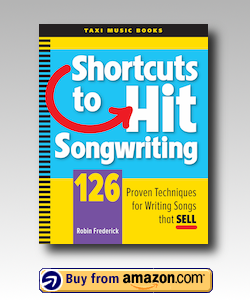
Shortcuts to Hit Songwriting

Buy at Amazon

"An excellent road map for writers at all levels. This is the songwriter's GPS!"
~Ralph Murphy,
V.P. ASCAP Nashville


"126 sharp tools, tips, exercises, and insights for every stage of creating your songs."
~John Braheny, author

Back to top

Blog & News...


Sat, Jun 26th, 2010 12:28 PM PDT

WRITE A UNIVERSAL LYRIC THAT'S EXCITING AND FRESH!

Robin Frederick (author "Shortcuts to Hit Songwriting")
 
Have you ever noticed how some people can describe a simple everyday occurrence and make it sound hilarious or tragic or just plain interesting, while another person can tell the same story and have you snoring with boredom in an instant? If the language you use is vivid and fresh even a familiar event or idea can come to life but if it's trite, overused, and predictable--in other words, if it's filled with clichés--even the most exciting story can become dull.
 
People often speak in clichés.
It's an easy form of shorthand that doesn't require much thought and ensures that everyone knows what you mean.  For example, here's a simple description of a common experience that's filled with overused phrases. (They're underlined.)
 
“I guess I got up on the wrong side of the bed this morning; I just couldn't seem to get in gear. I took the bus to work. It was so crowded people were packed like sardines. I was late getting to the office and the boss was hopping mad. The day seemed to drag on and on. I thought five o'clock would never come!”
 
While this paragraph gives you an idea of what the speaker's day was like, it doesn't make you feel the boredom and frustration. Familiar phrases such as “packed like sardines,” “hopping mad” and “seemed to drag on and on” have been so overused that they've lost their emotional impact. Listeners no longer picture the images or notice the comparisons.
 
Avoid clichés and still be universal.
A universal lyric is one that reaches out to a lot of people.  Sometimes songwriters think that writing a universal lyric means they have to use a lot of generic language, dumb down their lyric, or write what people expect to hear. That's not the case at all. Generic, predictable lines just waste space because listeners don't really hear them. Here are four ways you can get rid of overused, predictable phrases in your lyrics.
 
1. Use a fresh or unexpected comparison: Comparisons are a great way to add energy to a description. there was a time when “packed like sardines” was vivid, fresh, and funny. Listeners really pictured it when they heard it and it made them react. Eventually, so many people liked it and used it that the idea became stale and listeners stopped reacting.
 
You can create new comparisons that associate one idea with another in ways listeners haven't heard before. For instance, you could express exhaustion by saying, “I felt like a balloon that was losing air. Floating an inch off the ground, being kicked around.” Or describe a crowded bus: “People were wedged together like pieces in a jigsaw puzzle.”
 
2. Give it a character:  When you give human characteristics to an inanimate object, it literally brings it to life for listeners. Try personifying an object in your story: “Some days are criminal. They ought to be locked up.” Of course days are not criminals and no one can literally “lock up” a day but listeners are able to understand that this is what the day felt like.
 
3. Twist a cliché: You can use a cliché if you surprise the listener by creating a different payoff or explain it in a way that offers a new insight. Instead of “the day dragged on and on,” you might try, “the day dragged on and dragged me down.”
 
4. Change the order of events: Keeping to the logical progression of events is what listeners expect; it's a cliché story structure. While you don't want to alter things so much that the story becomes unclear, you could start with the end of the day, with the feeling of exhaustion, then work backwards, showing listeners what led up to it.
 
To hear good examples of lyrics that express universal ideas while avoiding or reworking clichés, listen to “Cannonball” by Damien Rice, Sarah McLachlan's “World on Fire,” and John Mayer's “Gravity.”
 
The Cliché Game
Rewrite these clichés using any or all of the four techniques listed above.
 
- I depend on you; you're my ace in the hole. 
- You think you've got it made, but soon you'll change your tune. 
- We fight like cats and dogs but things work out in the end. 
- The more I learn about you, the less I know. 
- I've got to get my feelings out; it's now or never.
 
You can keep on playing. Find more clichés online at web sites like http://www.clichesite.com. Practice rewriting them to get in the habit and exercise your creative muscle. Keep a list of your rewritten lines and refer to it next time you're looking for a song title or idea. Use one of your rewritten clichés as the basis for a song lyric.


Wed, Apr 7th, 2010 10:27 PM PDT

GO AHEAD... COLLABORATE

I just checked through the top five songs in the Rock, Country, AC, and Urban genres and, guess what... in all four genres at least four of the top five songs were collaborations. In the Country genre, all five were collaborations!

Collaborating has so many benefits that it's worth putting some real effort into learning how to do it and finding compatible songwriting partners to work with. It may take some time, maybe a few false starts, but it can more than repay you in the long run.

There are many reasons to collaborate: A collaborator can offer new ideas and nudge you out of old habits. If you fall in love with a line that isn´t working, a collaborator can point that out and keep the song moving forward. Working with a collaborator gives you added motivation, energy, and goals to meet. Chances are you´re stronger in one area (lyrics or music) than another; a collaborator can add strength where you're weak. The cost of demoing your song can be half what it would be if you wrote it alone.

So, why not collaborate? Do you resist collaborating because you're afraid that you're not good enough, or afraid you'll come up with dumb ideas... or no ideas? I totally understand. We all share those fears. Here are a few ideas that can help you get past them.

=> Give yourselves a chance to warm up. Start by playing a a few songs for each other. Find out where your tastes lie. Are they similar? Different? Agree on a style you want to write in to begin with. If your collaborator writes Classic Rock melodies and you're writing a Modern Pop lyric, you may have trouble fitting the lyric and melody together.

=> Create plenty of raw material to work from. Start by suggesting titles to each other. Use a newspaper or magazine and find short phrases that appeal to both of you. Choose a phrase to work on and make a list of questions you might answer in the song. Then make lists of words and phrases that the title phrase suggests: images, actions words, associations, opposites, whatever strikes you. Create more material than you think you'll need. Then, together, start assembling your chorus lyric. Try singing some of the phrases and start your melody.

=> Work long distance. You don't have to be in the same room. Plenty of collaborations take place on the Internet. Organize folders and files so you can easily find mp3s and lyrics for each song you work on. Make sure it's easy for you to receive music files. There are interesting sites like Dropbox (http://www.dropbox.com/features) that make it easy to share files. Use Skype for phone chats; it's free and has better sound quality than a regular phone.

=> Swap songs. Work on more than one song at a time, so that each of you always has a song to work on. Trade songs every few days.

=> Give yourselves permission to do a job. Too often we think of songwriting as something we must be brilliant at all the time. It's just a job, a hard job. Some days you do it better than others. Talk with your collaborator about experiences and expectations.

WHERE TO FIND COLLABORATORS
Clubs and music venues: You can find potential collaborators at clubs in your area. Try an open mic night. You'll find singer-songwriters in a variety of styles. If you can, play a few songs of your own so people get a chance to hear what you can do.

The Internet: You don´t have to limit yourself to songwriters in your area; the Internet makes long distance collaboration easy. Do your research. Look for established web sites with forums where songwriters meet to share songs, get feedback, and find collaborators. The Muse's Muse web site (http://www.musesmuse.com/) has a good one. Click on "Songwriting Message Board." Spend some time getting to know the regular contributors. Listen to their songs, read their lyrics, check out their melodies. When you find someone you think would make a good collaborator, go ahead and contact them. You can also check out the "Collaboration Corner" on the TAXI forum (http://forums.taxi.com/).

Now, go find somebody to play with!


Fri, Feb 12th, 2010 8:53 PM PST

WRITE SONGS FOR TV COMMERCIALS

Robin Frederick (author, Shortcuts to Hit Songwriting)
 
What was that song on the Delta Faucet commercial, the cute one that goes “So many things your hands can do”? It sounds like a children’s song, something maybe you might write for kids. Well, it is a children’s song. It’s from a Sesame Street record featuring The Count, the vampire Muppet who simply adores numbers. Could you write a song like that? You probably could and possibly you already have.
 
Advertisers use songs to link their product to an emotion. For the most part, they don’t use jingles anymore, those little ditties that sell a product by naming it (Oscar Meyer bologna) or telling you what it does (”Plop, plop, fizz, fizz. Oh, what a relief it is.”) Instead, we hear songs that have the emotional feel the advertiser wants to associate with the product. For example, Suburu used Sheryl Crow’s “Every Day is a Winding Road” for last year’s big ad. But you don’t have to be a hit songwriter to get a placement. For their current “Lost Sunglasses” commercial, Suburu used an unknown artist and song: Basia Bulat’s “Before I Knew.” Now, everyone is asking: Who’s that singer? What’s that song? And downloading it at iTunes.
 
=> Keep the lyric focused on a single emotional theme
To improve your chance of getting a commercial placement, choose an emotional theme that will appeal to advertisers. Look at the products that are being sold on TV and in magazines. Ask yourself: How can I get consumers to feel an emotion in connection with the product? Will it make them feel confident or happy? Will it bring their family closer together or attract love?
 
Construct your lyric around this emotional theme and stick with it. Don’t wander off. The Delta Faucet commercial creates a whimsical, upbeat feel bysimply giving us a fresh, imaginative list of things that hands can do–once they’re washed! It’s not the cleaning up that’s important but the appeal of having carefree, childlike fun!
 
=> Keep your melody simple and catchy
The trick to being simple and catchy is to NOT be simple, catchy, and predictable. Here’s a melody writing exercise that will give you an idea of what I mean: Create a chorus melody that’s simple and easy to remember. Record it into a handheld cassette or digital recorder so you have a record of your first idea. Then, begin playing around with it. Use a metronome or rhythm loop to establish the beat and begin exploring different ways you can change the rhythm of the melody. Try starting the melody later or earlier, adding a pause or taking one out, emphasizing weak beats like the upbeats (the “and” in between Beats 1, 2, 3, 4), stretching out notes or shortening them. If you have my book, use Shortcuts #88 through #93 to give you some more ideas. Read the ‘Study the Hits” entry below for more insights.
 
=> Production
There are many hot songs in commercials that are very simply produced–just listen to the solo piano/vocal on Amazon’s Kindle ad! Or remember the Volkswagen Cabrio ad that used Nick Drake’s guitar/vocal “Pink Moon.” You can research the field of advertising songs at web sites like AdTunes( http://www.adtunes.com) or SplendAd (http://www.splendad.com). At SplendAd, you can often view the commercial which means you can study it without having to watch hours of television, hoping it will be on!
 
Once your song is written, you’ll need a broadcast quality recording to pitch, but if you keep the arrangement simple, you could rent a studio and record it in an hour or two. Use a vocalist that fits the style of the song. Is it a fragile female singer or a warm and friendly male? Or a distinctive voice with loads of character?
 
Music Libraries are interested in this type of song, knowing that it appeals to ad agency Music Directors. You can submit your demo to many music libraries through TAXI (http://www.taxi.com). Some Music Libraries, like Rumblefish and Global Graffiti (http://www.globalgraffiti.com) will accept submissions online.
 
So many things songwriters can do!


Sun, Nov 29th, 2009 8:27 PM PST

NEW ADDITIONS TO "STUDY THE HITS"

NEW: What songwriting techniques are today's hit songs using? How can you use them in your own songs? Check out my analysis of Taylor Swift's "You Belong With Me" and Matt Nathanson's "Come On Get Higher" on the STUDY THE HITS page and find out!


Sat, Nov 28th, 2009 1:19 PM PST

STRENGTHEN AND POLISH YOUR MELODY

Robin Frederick (author, Shortcuts to Hit Songwriting)

Let’s say you’ve just spent the afternoon writing a song and you feel you’ve got a good start on a first draft. The concept is strong, the structure feels right. Of course the lyric still needs work but you’re planning to go back and rewrite it. How about the melody? Will you go back and rewrite that, too? Or will you stick with what came to you on the first pass?

Many times, a songwriter who wouldn’t dream of settling for a rough draft of a lyric, accepts the first melody that comes along. Often these melodies are the result of old habits; they may sound dated and familiar. The writer may not even know that a melody can be rewritten, strengthened, and polished just like a lyric. To be fresh and current-sounding, give your melody the advantage of a solid rewrite.

=> Is your melody clearly conveying the song’s structure? 
Create plenty of contrast between sections–verse, chorus, and bridge–by using a change of note range (low vs. high), note pace (fast vs. slow, choppy vs. smooth), or melodic rhythm patterns (different patterns of long and short notes).

=> Do you have a good balance of repetition and variation?
Check to see if you’re repeating the same note phrases and the same phrase lengths too many times. Listeners do like repetition, but too much begins to feel predictable and boring. Repeating a line once (sing the line, then sing it again) can be fine, but repeating it yet another time can be flirting with disaster. Try varying the note pitches and phrase lengths, create a surprise for listeners that will keep them interested.

=> Are your phrases well organized?
This may seem like an odd question but one of the hallmarks of hit songs–songs that a lot of listeners really like–is good melodic organization. Many hit songs use the following layout in the chorus melody: Sing the first line or phrase, repeat that phrase (with a different lyric), go to a new phrase and repeat it, then return to the first phrase with some variation. This is just one idea. Check out a few hit song choruses to see if you can hear how their melodies are organized.

There are many more ways to rewrite, refine, and strengthen your melody. Your goal is to write a melody that appeals to you and your listeners while underscoring your lyric with plenty of emotion. Try some of the ideas in this tip. If you make a change in your melody that doesn’t work for you, just hit the “undo button” and go back to what you had before.

argin-top: 5px; margin-right: 0px; margin-bottom: 5px; margin-left: 0px; font-size: 12px; line-height: 14px; color: #000000; padding: 0px;">
Copyright 2009 Robin Frederick. All rights reserved.br>

“Shortcuts to Hit Songwriting” is available at Amazon.com

For daily song tips: Twitter/RobinFrederick


Next page >>

Over her twenty-five years in the music industry, Robin Frederick has written more than 500 songs for television, records, theater, and audio products. She is a former Director of A&R for Rhino Records , Executive Producer of 60 albums, and the author of "Shortcuts to Hit Songwriting." Robin currently oversees the A&R Team for TAXI, the world's leading independent A&R company.

Robin's book...
Shortcuts to Hit Songwriting:
126 Proven Techniques for Writing Songs That Sell"

is available at ...

Buy at Amazon