






Skip to: site menu | section menu | main content


Shortcuts to Hit Songwriting


Write a Song

Songwriting Tips

Songwriters' Sandbox

Song Resources

Study the Hits

Blog & News

Join my Email List for more tips & updates...
(Your email address is always private.)

Guestbook

For daily songwriting tips, follow me on... Twitter


Praise for Robin's book...

"For people serious about writing great songs. It's got it all!"
~Kara DioGuardi, hit songwriter & American Idol judge


"Should be in every songwriter's arsenal."
~Jason Blume, hit songwriter, author

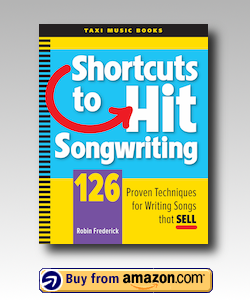
Shortcuts to Hit Songwriting

Buy at Amazon

"An excellent road map for writers at all levels. This is the songwriter's GPS!"
~Ralph Murphy,
V.P. ASCAP Nashville


"126 sharp tools, tips, exercises, and insights for every stage of creating your songs."
~John Braheny, author

Back to top

Blog & News...


Mon, Sep 7th, 2009 11:38 AM PDT

LYRICS: WRITING A STRONG OPENING LINE


by Robin Frederick (author of “Shortcuts to Hit Songwriting”)
 
Question from a songwriter: "I have trouble coming up with the first line of a song. I try not to write the first line as something obvious and cliche  but I can't seem to figure out how to keep it from being too vague."
 
Answer: Your question about writing a strong opening line is a good one. This is a key line in your song, one that may make the difference between keeping a listener tuned in  or losing their interest. You're right about not wanting to be vague! Here are a few ideas...
 
1) After you have a first draft of your song, check to see whether your second verse is stronger than your first. This can happen as you get deeper into the song and know more about what you want to say. Try opening with your second verse and writing a new one to replace it. 
 
2) If the song is addressed to "you," what is the one big, emotional statement you want to make to that person? Try starting with that if you're not using it somewhere else in the song. If you are already using it, try backing up a step and imagine the line that would come just BEFORE you said that. 
 
3)  Work from your chorus. Read the chorus out loud, then try to find a line that answers the question: Why am I saying this? 
 
4) An effective opening line pulls the listener right into the middle of the action or situation. Look for the moment that seemed to trigger the situation you're writing about. Start by describing that - what was said, what did you do?
 
5) Choose an action word or visually descriptive word that conveys the situation and build a line around that.
 
As you can see from these suggestions, it's often a good idea to revisit your first line AFTER you work up a draft of your song. In the meantime, use a line that gets you started and worry about adding strength to it later. Turn off your inner critic and just write what you feel. Rewriting is where you'll use ideas like the ones listed above. Once you have a solid opening line, you'll probably need to rework the rest of your first verse but it's worth it! 

 
Shortcuts to Hit Songwriting” by Robin Frederick. Available at Amazon.com. Copyright 2009 Robin Frederick. All rights reserved.


Mon, May 25th, 2009 9:21 AM PDT

SONGWRITING AND INSPIRATION

 
by Robin Frederick (author of “Shortcuts to Hit Songwriting”)
 
Most songwriters sit down to write when they are going through an emotional time, when feelings are running high. Many great songs -- many hit songs -- have been written from a songwriter's private life - the joy, love, grief, and anger of the writer's own relationships. 
 
So, what happens when a songwriter who has been writing solely from personal experience begins to (or wants to) earn a living from their writing?  Let's say you're a singer-songwriter with a record deal and you have to write ten new songs for an upcoming album... or you're a staff writer with a publishing deal who needs to write on demand. Can you rely on your life to provide enough material to keep the songs flowing? Probably not. Even if you could, it might not be the kind of life you'd want to live! 
 
Here are a couple of ideas that can help you get around this problem:
 
> Use the past.
You already know that as a songwriter you need to write from your heart; you want to express your own thoughts and feelings. If your life isn't currently filled with drama, try reaching back into the past for an event that still resonates for you, a conversation, person, or situation that has stayed in your memory. If you've already written a song or songs about it, consider looking at it from another angle. Try putting yourself in the other person's place and seeing it from their point of view or use something you've learned since that time to add a fresh perspective.
 
> Imagine a situation.
Shakespeare didn't have to endure a visit from the ghost of his dead father in order to write Hamlet. By imagining himself in Hamlet's situation, he was able to create dialogue filled with honest emotions that have moved audiences for hundreds of years. A good writer, whether of plays, songs, or novels, doesn't have to experience every situation himself in order to write about it truthfully.  
 
The poet John Keats called this ability to project oneself into another's emotional life "negative capability." By this he meant a writer's ability to lose his own ego and become the character he's writing about. I just call it empathy. A good writer is one who can feel what others are going through and identify with their emotions. As soon as you can do that, you can write about it.
 
We all experience empathy when we lose ourselves in a good movie, book, or TV program, when we cry over a sad ending or care about what happens to the hero. You can use these empathic feelings as the basis for new songs. 
 
Do It Now! 
Choose a situation from your past or watch a dramatic TV show or movie and pick a scene that interests you. Write out  the situation in your own words. Try to get inside the emotions of someone in the scene -- really BE there. Imagine your surroundings, the past that led up to it and what might happen next.  What emotions are you feeling? What you want to say and do in this situation. Make a list of phrases and ideas that describe what you're feeling. Choose one of these phrases and make it the title of your song. For a variation on this idea, choose your material from a cable news channel and base your song on real people and events.  
 
In my book, "Shortcuts to Hit Songwriting," there are several techniques that will help you develop a complete  lyric from your title (Shortcuts #44 - #47), then use the lyric to suggest the raw material for a melody. 
 
 
Based on “Shortcuts to Hit Songwriting” by Robin Frederick. Available at Amazon.com. Copyright 2009 Robin Frederick. All rights reserved.


Sat, May 9th, 2009 11:36 AM PDT

WRITING SONGS FOR YOURSELF AND YOUR LISTENERS

 
by Robin Frederick (author of “Shortcuts to Hit Songwriting”)
 
 
What makes you write a song? 
-  the desire to put your feelings into words? 
- wanting to reach out to others to express a thought or message? 
- the hope that eventually it will earn royalties? 
 
The truth is, a song can do all this if you keep these three goals in mind as you write. 
 
- Write to express your own emotions. Stay connected with your initial reason for writing the song. What is it you want to say? What emotion do you want to convey? Even if your goal is to write a hit song, you MUST stay connected to your original emotional inspiration!
 
Write a summary of your song in a sentence or two and keep it to refer to. When you get into the actual writing of your song, it's easy to get lose sight of your initial idea. If a strong lyric line suddenly occurs to you, ask yourself if it really belongs in the song you're working on. Maybe it's an idea for a different song. Don't bend your theme out of shape to accommodate that one line. Write down or record your idea, then put it aside temporarily until you figure out where it belongs. Stay with your original inspiration and you'll end up with a song that expresses your feelings and thoughts. 
 
A good song is any song that expresses your  emotions in a way that's satisfying for you. But... if you want to reach out and express those feelings to listeners, you may need to blend more song craft into your writing. Song craft is a body of knowledge that has been developed by songwriters over decades, even hundreds of years. It's based on how listeners react: What draws them in? What turns them off? For instance, listeners like a song that has a repeated chorus section. But if that chorus is just repeated over and over, they get bored. If there's a verse that gives them more information in between the choruses, listeners remain interested and involved. That's an example of song craft.
 
Craft doesn't limit creativity!
If you want to write a song in the hope of getting it published, recorded by a well known artist, or used in film or TV (a major outlet for today's songs), then you'll want to do both of the things I've just described: Stay connected to your emotional theme and use song craft to communicate with listeners. Melody and lyric writing techniques can be adapted and built on in endless ways, so don't think of craft as limiting your creativity! Approach it with a playful, experimental attitude. 
 
Once you reach out to listeners with a strong emotional message, well-developed, evocative lyrics, and a memorable, fresh melody, you've got the kind of song the music industry needs. So, if your goal is to write a song that will earn royalties, aim for a blend of emotion and craft. Remember...
 
- If you write a song with emotion but no craft, listeners may not understand you. 
 
- If you write a song with craft but no emotion, listeners may not care!


Based on “Shortcuts to Hit Songwriting” by Robin Frederick. Available at Amazon.com. Copyright 2009 Robin Frederick. All rights reserved.


Fri, Apr 24th, 2009 8:52 PM PDT

Nick Drake Tribute Concert

I'll be appearing at a Nick Drake Tribute Concert in Birmingham, U.K. on Saturday evening, May 16, alongside Beth Orton, Martha Wainwright, Robyn Hitchcock, and Vashti Bunyan  performing the songs of Nick Drake. Actually, I won't be singing, I'll be talking about Nick's remarkable songwriting skills and the reasons why he is considered one of the finest songwriters of our time. On Sunday, May 17, I'll be appearing on a panel with Joe Boyd, Nick's producer, and Robert Kirby his arranger, for more discussion of Nick's musical life and legacy.


Sun, Apr 5th, 2009 8:43 PM PDT

CREATE A DEVELOPMENT PATH FOR YOUR LYRICS

 
It can be tough to find the balance between giving listeners too much information too quickly and not giving them enough or repeating information they’ve already heard.
 
As you write your verses and bridge, keep the path through your song clear. Make sure things are moving forward, not going in circles or repeating the same thing over and over.
 
Here are two development paths your song might take. Notice that each path leads the listener into and through a situation, keeping the momentum rolling forward and giving new information as it goes along. 
 
The chorus is integrated into the song as a natural extension of the verses and bridge. (The vast majority of hit songs are written from the point of view of the singer—the first person “I”—so I’ll use that approach in these examples.)
 
Path #1 – Deal with a problem
 
Verse 1: This is the problem.
Chorus: Here’s how I feel about it.
Verse 2: This is what I tried to do about it.
Chorus: Here’s how I feel about it.
Bridge: This is how I hope to find a way through this.
Chorus: Here’s how I feel about it.
 
 
Path #2 - Give us a history
 
Verse 1: I remember the great beginning of our love.
Chorus: This is what it felt like.
Verse 2: Things changed. Everything is different now.
Chorus: This is what it felt like.
Bridge: Can we get back to the way things were?
Chorus: This is what it felt like.
 
 
You can find more development paths by listening to well-written hit songs. You’ll notice that some songs share similar paths. It’s how the path is personalized by the songwriter that makes it unique and gives it strength. A path is just the outline of a song. How you flesh it out is up to you. Make each path your own with the details and emotions of your specific situation and characters.
 
 
Based on “Shortcuts to Hit Songwriting” by Robin Frederick. Available at Amazon.com. Copyright 2009 Robin Frederick. All rights reserved.


<< Previous page Next page >>

Over her twenty-five years in the music industry, Robin Frederick has written more than 500 songs for television, records, theater, and audio products. She is a former Director of A&R for Rhino Records , Executive Producer of 60 albums, and the author of "Shortcuts to Hit Songwriting." Robin currently oversees the A&R Team for TAXI, the world's leading independent A&R company.

Robin's book...
Shortcuts to Hit Songwriting:
126 Proven Techniques for Writing Songs That Sell"

is available at ...

Buy at Amazon